
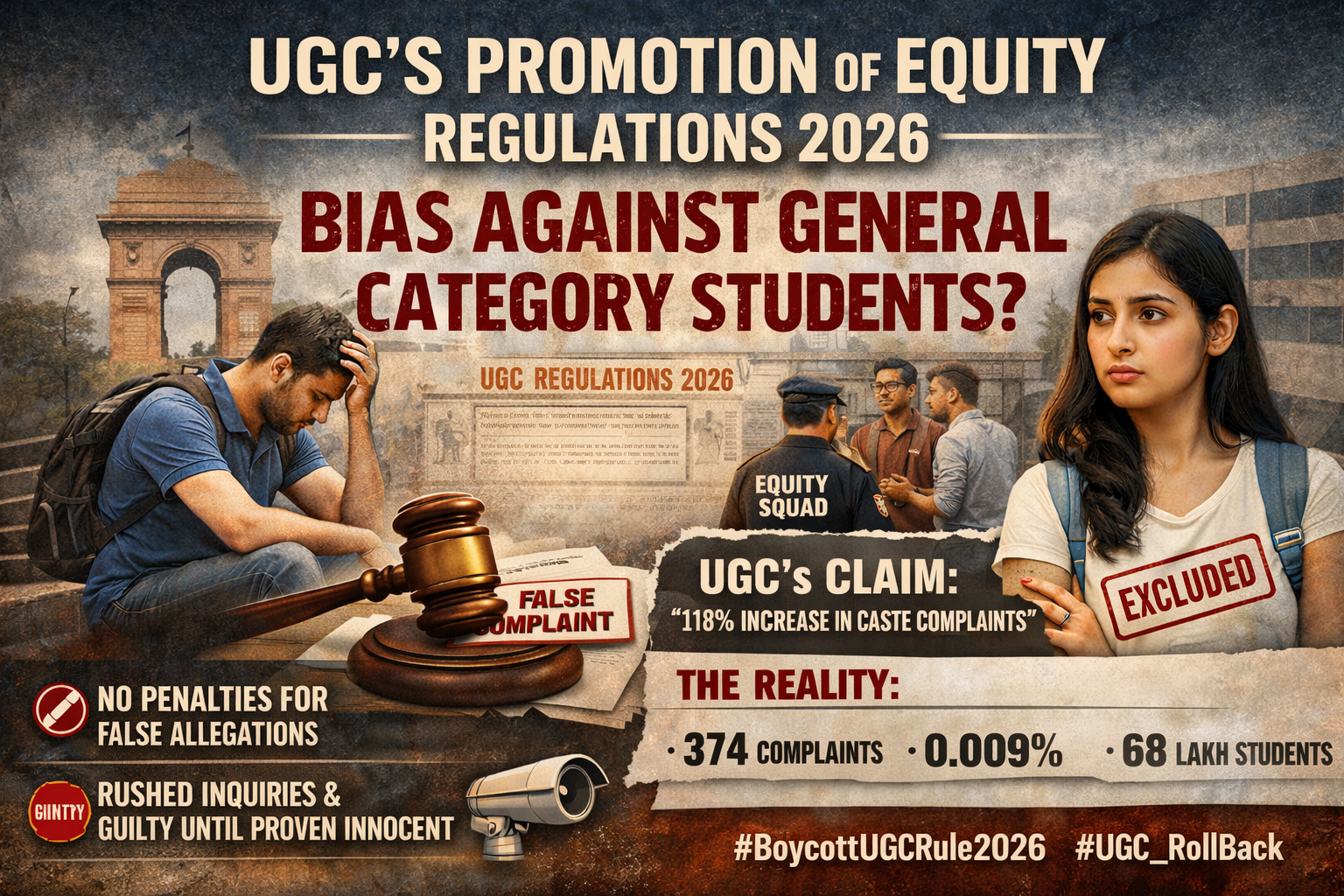
The University Grants Commission (UGC) has notified the Promotion of Equity in Higher Education Institutions Regulations, 2026, effective from January 13, 2026. Promoted as a framework to prevent caste-based discrimination on campuses, the regulations are drawing intense criticism for allegedly creating a skewed system that disadvantages general category (unreserved) students and fails to provide balanced safeguards against misuse.
What the New Regulations Mandate
The new regulations apply to all higher education institutions (HEIs) — including universities, colleges, and deemed universities — and require institutions to establish a comprehensive compliance architecture:
- Equal Opportunity Centres (EOCs)
- Equity Committees with mandatory SC/ST/OBC/women/PwD representation
- Equity Ambassadors
- Mobile Equity Squads
- 24/7 helplines and online complaint portals
- Rapid grievance redressal with committee meetings within 24 hours and reports in 15 days
Institutions that fail to comply face severe penalties, including debarment from UGC funding, loss of degree programmes, or withdrawal of institutional recognition.
One-Sided Victimhood Framework
A central point of controversy is the way caste-based discrimination is defined. The regulations describe discrimination primarily as acts committed “particularly against” SCs, STs, OBCs, EWS, and persons with disabilities. Critics argue that this definition explicitly excludes general category students from equivalent statutory protections, leaving them without a clear mechanism to address caste-related harassment or slurs.
Legal scholars note that while the Constitution allows asymmetric protections under Articles 15(4) and 16(4), a grievance system that only provides channels and protections to specific categories raises serious questions under the broader equality guarantees of Articles 14 and 15.
No Penalties for False or Malicious Complaints
One of the most widely criticized omissions in the final regulations is the absence of penalties for false or malicious complaints. Earlier drafts reportedly included fines or disciplinary consequences for proven false allegations, but these were removed in the final version. Without such safeguards, critics argue, baseless or vindictive complaints can cause irreversible reputational harm and academic disruption for accused individuals.
Rushed Processes and Presumption of Guilt
The regulations mandate aggressive timelines and procedural structures that many opposition voices describe as procedurally unbalanced. Committees must meet within 24 hours of a complaint and issue reports within 15 days. Combined with the allowance of anonymous complaints and pressure on institutions to demonstrate compliance or face penalties, critics warn this framework encourages fear-driven action rather than evidence-based justice.
UGC’s Claims on Rising Complaints: Numbers vs. Narrative
The UGC has defended the new regulations by citing a sharp rise in reported caste-based discrimination cases, repeatedly highlighting a 118% increase over the last five years as justification for sweeping reforms.
However, critics say this figure is a classic case of statistical manipulation through selective framing.
According to UGC-submitted data:
- 2019: 173 complaints
- 2024: 374 complaints
- Increase: 118% (numerically correct)
But opponents argue that the absolute scale tells a very different story.
These complaints came from 2,257 institutions (704 universities and 1,553 colleges), with an estimated 68 lakh students enrolled across them. Even if one assumes that 60% of these students (around 40 lakh) belong to SC/ST/OBC categories and are the only possible victims under the regulation’s definition, the 374 complaints represent just 0.009% of that population — a statistically negligible fraction.
Looking at the broader national context, India has approximately 4.33 crore UG and PG students across all institutions. Against that base, 374 complaints nationwide amount to less than 0.001% of the student population.
Critics further point out that national data suggests that over 90% of formal complaints in grievance systems are eventually found to be false, exaggerated, or unsubstantiated. If even a conservative version of this trend applies here, the number of genuine cases could be a few dozen nationwide — yet the issue has escalated into:
- A nationwide policy overhaul
- Supreme Court scrutiny
- Parliamentary debates
- Wall-to-wall media coverage
Opponents accuse the UGC of hiding small absolute numbers behind dramatic percentage growth to manufacture a sense of crisis and justify regulatory overreach.
Surveillance Culture and Campus Policing Concerns
In addition to grievance structures, the regulations introduce Equity Squads and Equity Ambassadors tasked with monitoring campus spaces and behavior. Opponents argue that these entities could foster an atmosphere of constant observation, ideological policing, and self-censorship, rather than genuine harmony. They also warn that the framework could incentivize caste identity weaponization in personal disputes or academic disagreements.
Social Media Backlash and Public Outcry
The reaction on social media has been intense. Hashtags such as #BoycottUGCRule2026, #UGC_RollBack, and #UGC_वापस_लो have trended widely, with students, alumni, and commentators branding the regulations as “reverse discrimination”, “campus apartheid”, and a betrayal of merit-based principles.
Petitions calling for immediate withdrawal and revision of the rules have gained traction nationwide. Several commentators have also warned that the regulations may discourage general category students — especially women — from enrolling or remaining in public institutions due to fear of reputational and academic harm from false accusations.
Calls for Symmetrical and Constitutional Revisions
Critics are not opposed to anti-discrimination mechanisms per se, but many demand revisions that protect every student equally and incorporate balanced procedural safeguards, including:
- Universal grievance redressal for all students
- Penalties for proven false complaints
- Clear standards of proof
- Neutral and independent oversight
- Limits on anonymous accusations
- Transparent appellate mechanisms
Legal observers warn that without these safeguards, the regulations risk institutionalizing bias, chilling free speech, and undermining trust in campus justice systems.
What Lies Ahead
As institutions rush to implement the new compliance framework, the controversy shows little sign of abating. With ongoing student protests, legal scrutiny, and public debate, pressure is mounting on the UGC and the Ministry of Education to revisit and revise the regulations.
The central question now is whether the Promotion of Equity Regulations will deliver genuine campus harmony or institutionalize new forms of bias and polarization.
This article reflects ongoing public criticism and independent analysis of the UGC’s Promotion of Equity in Higher Education Institutions Regulations, 2026.
- One-Sided Victimhood Framework
Caste-based discrimination is defined primarily as acts “particularly against” SCs, STs, OBCs, EWS, and persons with disabilities. General category students — often stereotyped as “savarna” or privileged — are excluded from equivalent protections. If a general category student faces caste-targeted harassment (slurs like “ponnga pandit,” exclusion, or threats), these rules provide no dedicated recourse. This entrenches a permanent “oppressor vs. oppressed” divide, ignoring reverse bias and violating constitutional equality under Articles 14 and 15. - No Penalties for False or Malicious Complaints
The earlier draft included fines or disciplinary action for proven false allegations — a basic deterrent. This clause was entirely dropped in the final version. Without consequences, baseless or vindictive complaints become low-risk weapons. An accusation alone can spark immediate institutional action: inquiries, suspensions, social ostracism, or academic disruption against the accused (typically general category students/faculty), often before fair evidence review. Social media is rife with fears of “legal terrorism” on campuses. - Rushed, Biased Processes and Presumption of Guilt
Accelerated timelines and mandatory reserved-category-heavy committees prioritize speed and compliance over balanced justice. Complainant anonymity is permitted, while the accused risks exposure. Institutions, fearing UGC sanctions, may rush to “act” rather than investigate thoroughly. This setup risks superficial probes, denial of due process, and quick findings of guilt — turning everyday interactions (debates, projects, remarks) into potential “casteist” triggers. - Surveillance and Grievance Culture
Equity Squads patrolling “vulnerable spots” and ambassadors promoting anti-discrimination programs evoke ideological policing. Critics warn this fosters constant suspicion, self-censorship among general category students, and weaponization of caste identity for personal grudges, boycotts, or silencing dissent. Merit-based discussions and academic freedom could suffer in politically charged environments like JNU or DU.
Social media is exploding with outrage — hashtags like #BoycottUGCRule2026, #UGC_RollBack, and #UGC_वापस_लो trend as students, alumni, and influencers label it “apartheid on campuses,” “reverse discrimination,” and a betrayal of merit. Petitions demand immediate withdrawal, arguing it deepens caste divides instead of healing them. Prominent voices, including journalists and activists, call it a disaster that could drive general category students (especially girls) away from public institutions. The rules risk turning campuses into zones of fear and polarization. As HEIs rush to comply, the backlash grows louder: Will this promote genuine harmony, or institutionalize bias and destroy trust? The mounting calls for rollback suggest the latter — and a demand for fair, constitutional revisions that protect every student equally.
This article reflects widespread public criticism and analysis of the notified regulations. Share your thoughts in the comments below.