
A policy decision that reflects a deeper contradiction in India’s governance
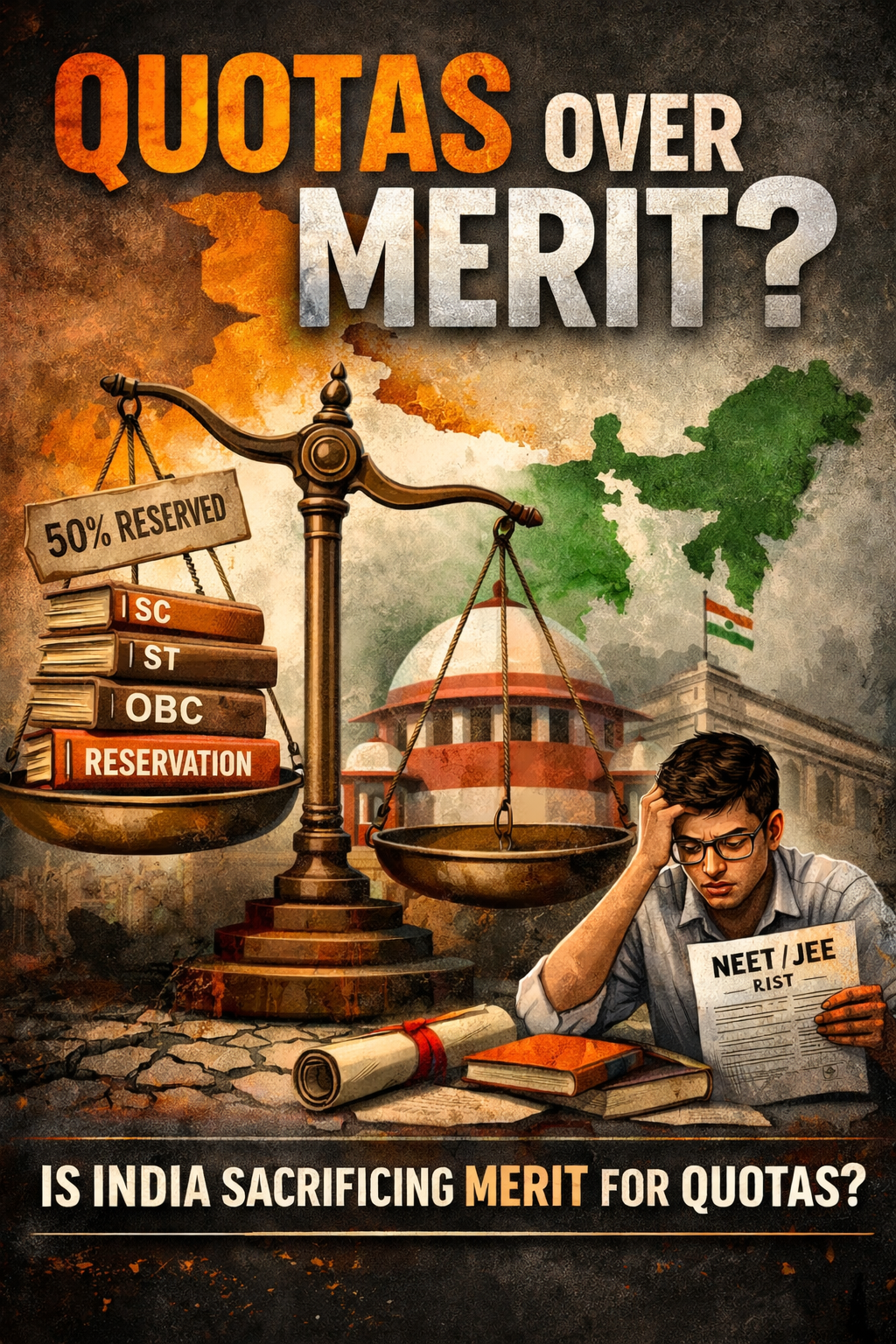
Bhubaneswar: In a late-night cabinet decision on April 4, the Odisha government approved a sweeping expansion of reservations in professional courses, pushing the total quota to 50%, the upper limit referenced in Supreme Court rulings.
The revised structure significantly increases quotas for Scheduled Castes (SC) and Scheduled Tribes (ST), while introducing a new allocation for Socially and Educationally Backward Classes (SEBC). Under the new framework, SC reservation rises to 16.25%, ST to 22.50%, and SEBC is allotted 11.25%, nearly doubling the earlier combined share of around 20% for SC and ST.
The policy applies to critical fields such as medicine, engineering, nursing, and pharmacy—areas where competence is not optional, but essential.
A System Moving Away from Merit
With half of all seats now reserved, the space for open, merit-based competition is effectively cut in half.
This is not a minor adjustment—it is a structural shift.
In highly competitive exams like NEET and JEE, where lakhs of students compete for limited seats, such policies fundamentally alter the meaning of competition itself. For many students, success is no longer determined purely by performance, but by category-based allocation.
The Larger Pattern Cannot Be Ignored
This decision does not exist in isolation.
It comes in the backdrop of the UGC Equity Regulations 2026, which were recently stayed by the Supreme Court, not scrapped. During the proceedings, the Court observed that certain provisions appeared “vague” and prone to misuse, raising concerns about their broader impact. The matter remains under judicial review.
Together, these developments point toward a growing trend:
expansion of identity-based frameworks even as their design faces constitutional scrutiny.
Unity in Words, Division in Policy
The contradiction becomes sharper when seen alongside political messaging.
On one hand, there are repeated calls for Hindu unity beyond caste divisions, often expressed through slogans like “Batege toh katege”.
On the other hand, policies continue to institutionalize caste as the primary determinant of opportunity.
This raises a fundamental question:
Can a society claim unity while structuring access based on division?
Merit: The Foundation of Critical Professions
In professions like medicine and engineering, outcomes are real and immediate:
- A doctor’s error can cost lives
- An engineer’s mistake can compromise infrastructure
In such fields, selection based on demonstrated ability and performance is not an ideological preference—it is a practical necessity.
Reducing the weight of merit in these domains risks weakening the very systems that society depends on.
The Silent Consequences
Beyond policy language, the long-term effects are already visible in broader discussions:
- Growing frustration among high-performing students
- Increasing inclination toward private institutions or opportunities abroad
- A perception that outcomes are influenced more by identity than effort
There are also concerns that benefits may not always reach the most disadvantaged, while opportunities for others continue to shrink.
🧠 The Psychology of Merit and Motivation
The importance of merit is not just economic—it is psychological.
Research in human motivation consistently shows that people perform best when they believe outcomes are linked to effort and ability.
Self-Determination Theory, developed by psychologists Edward Deci and Richard Ryan, highlights that individuals thrive when they experience:
- Competence
- Autonomy
- Recognition based on performance
Similarly, Carol Dweck’s growth mindset theory emphasizes that people are more likely to improve when success is seen as the result of effort, not fixed identity.
When systems shift focus away from performance toward identity, it can weaken:
- Motivation to excel
- Belief in personal agency
- Trust in fairness of outcomes
The Real Issue: Addressing Roots, Not Symptoms
If inequality exists—and it does—the solution lies in:
- Strengthening school education
- Improving access to resources
- Creating equal starting conditions
Expanding quotas at the final stage of selection does not solve these foundational gaps. It merely redistributes limited opportunities without addressing the underlying problem.
A Turning Point
Odisha’s decision reflects a broader national direction.
As policies move closer to maximum quota limits across sectors, India faces a critical choice:
Will the system prioritize performance and competence, or continue expanding identity-based allocation?
Final Thought
Merit is not about privilege.
It is about measurable ability, effort, and readiness.
A system that weakens merit does not create equality—it risks creating new forms of imbalance, where fairness itself is questioned.
What Do You Think?
Should professional education be driven primarily by:
- Merit and performance, or
- Category-based allocation?
💬 Share your views in the comments.