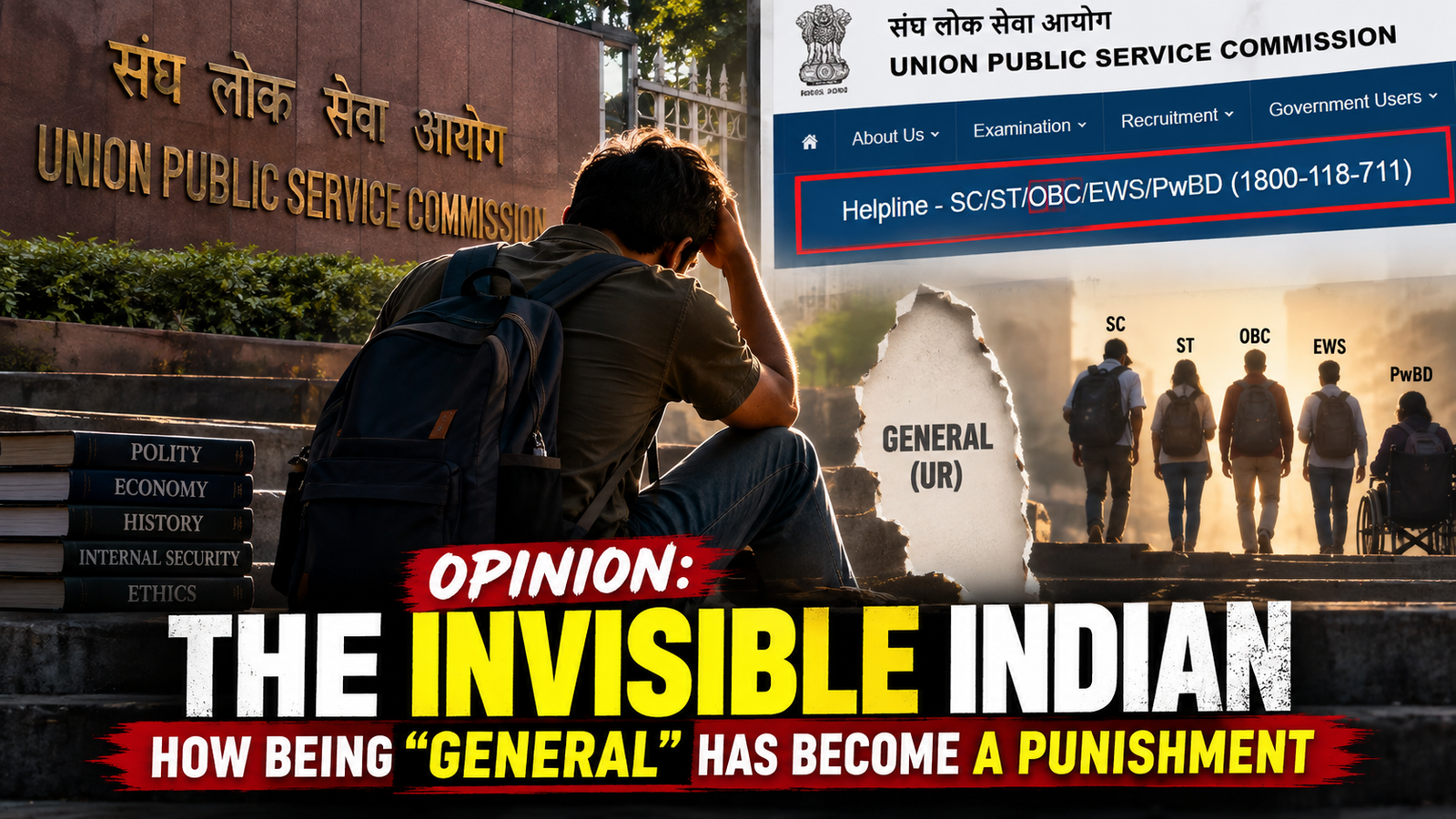
The Union Public Service Commission was created to recruit the people who would form the administrative machinery of India—the civil servants who are often described as the “steel frame” of the country. Yet, when you visit the official UPSC website today, you notice something that may seem small at first, but becomes increasingly difficult to ignore when you think about what it represents. Under its helpline section, the UPSC specifically mentions SC/ST/OBC/EWS/PwBD. The categories are clearly listed, with a dedicated helpline for them. But there is one category that is conspicuously absent: General, or Unreserved (UR).
Where Is the General Category?
The question is simple: where is the General category? Where is the UR candidate? Why has the exclusion of the General category from government policies, facilities and institutional mechanisms become such a normal feature of modern India that hardly anyone even questions it anymore?
This is not about asking for special treatment for General-category candidates. It is about asking for something much more basic: equal recognition as citizens. A person who belongs to the General category does not stop being a citizen of India. Yet increasingly, the impression is that the state has become extremely comfortable designing policies around categories that receive specific protections or benefits while treating the Unreserved category as though it does not need to be considered at all.
The UPSC Example
The UPSC examination provides perhaps one of the clearest examples of how this burden compounds over time. A General-category candidate faces the highest qualifying threshold while also having the lowest number of permitted attempts. Under the existing rules, General and EWS candidates are permitted six attempts, while OBC candidates get nine and SC/ST candidates have unlimited attempts, subject to the applicable eligibility conditions.
The question is straightforward: if a General-category candidate is expected to clear the highest threshold, why should that same candidate have the lowest number of opportunities to do so? What is the logic behind expecting the candidate to compete at the highest level while giving him the smallest margin for failure?
This is not merely about one attempt or one examination. It is about the cumulative effect of these rules over the years.
When Discrimination Starts Compounding
For a young student, category is something decided before he or she is even old enough to understand what it means. A child does not choose the family into which he is born, the category written on his documents, or the circumstances that come with it. Yet, as that child grows older, the consequences of belonging to the General category can follow him into education, competitive examinations, fees, scholarships, eligibility criteria and opportunities.
One disadvantage may appear insignificant on its own. But when several such disadvantages accumulate over years, they create a very different reality for the person living through them.
A General-category student preparing for a competitive examination may spend years studying, paying for books, coaching, test series, accommodation and other expenses, while knowing that the margin for error is extremely small. One unsuccessful attempt is not simply a bad result; it also consumes one of a limited number of opportunities. The cutoff can be higher and the room for failure narrower. Yet this reality rarely receives the same institutional attention that other categories routinely receive.
The Child Does Not Choose His Category
This is the part that we seem to have forgotten. No child chooses to be born General.
A child has no control over the category into which he is born. Yet we have created a system in which that category can determine how much institutional consideration he receives later in life. We tell the General-category student that he must compete, perform and succeed without asking whether the burden placed upon him has also become excessive.
Being born into the General category should not automatically mean being born into a lifetime of having to prove that your difficulties are real.
The Mental Cost Nobody Talks About
There is also a mental cost to this that is almost never discussed. Imagine being a young student who has spent years preparing for an examination, only to repeatedly hear that your category is the one expected to compete without additional consideration.
You are told that you have the highest cutoff to clear, fewer attempts to use and little institutional sympathy because you are considered part of the “general” population. Over time, this can create a feeling that the system does not merely expect you to compete—it expects you to compete while remaining invisible.
And that invisibility is perhaps the most disturbing part of it.
General Does Not Mean Problem-Free
The problem is not that the government recognises disadvantaged communities. The problem begins when recognition becomes so one-directional that an entire category of citizens starts disappearing from the conversation.
General is treated as though it means privileged, and privileged is increasingly treated as though it means that no disadvantage can ever exist.
But people do not live their entire lives inside a government-defined category. Economic hardship, family circumstances, lack of resources, unemployment, regional disadvantages and countless other difficulties do not automatically disappear because someone’s certificate says “General.”
A General-category student can be poor. He can come from a family with no political connections. He can be the first person in his family to prepare for a competitive examination. He can spend years struggling to reach the same examination hall as everyone else. His category does not tell you the complete story of his life.
We Have Normalised the Invisibility
Somewhere along the way, we have allowed a dangerous assumption to become normal: that if someone belongs to the General category, then the state does not need to worry about them.
Their problems are assumed to be less important. Their struggles are assumed to be self-inflicted. Their failures are assumed to be the natural outcome of competition. And their demands for fairness are often dismissed before they are even heard.
This needs to change.
I Want an India Where “General” Does Not Mean Invisible
I want to see an India where being General does not mean being invisible. I want to see an India where an Unreserved candidate can raise a legitimate grievance without immediately being reduced to the stereotype of someone who is simply complaining about reservation.
I want to see an India where equality before the state does not depend on which category is printed on a person’s certificate.
The General category should not be treated as the category that requires nothing simply because it is called “General.” General should mean equal—not expendable. Unreserved should mean open to competition—not excluded from consideration.
If the state can create dedicated mechanisms to recognise the concerns of different categories, there is no reason why an ordinary citizen belonging to the UR category should have to wonder whether the system even remembers that he exists.
Equal Citizenship Cannot Have an Asterisk
Perhaps the most uncomfortable question for the future is this: how did we reach a point where being born into the General category could come to mean accepting a lifetime of compounding disadvantages without even being allowed to call them disadvantages?
I do not want a future India where children are taught that their category determines how much fairness they deserve from the state. I want an India where every citizen can look at the institutions of the country and feel that they belong there.
An India where the state does not become blind to someone simply because he was born into the “wrong” category.
Because being General should not be a punishment. Being Unreserved should not mean being unheard. And being outside a reservation category should never mean being outside the moral concern of the Indian state.
UR citizens are citizens too.