
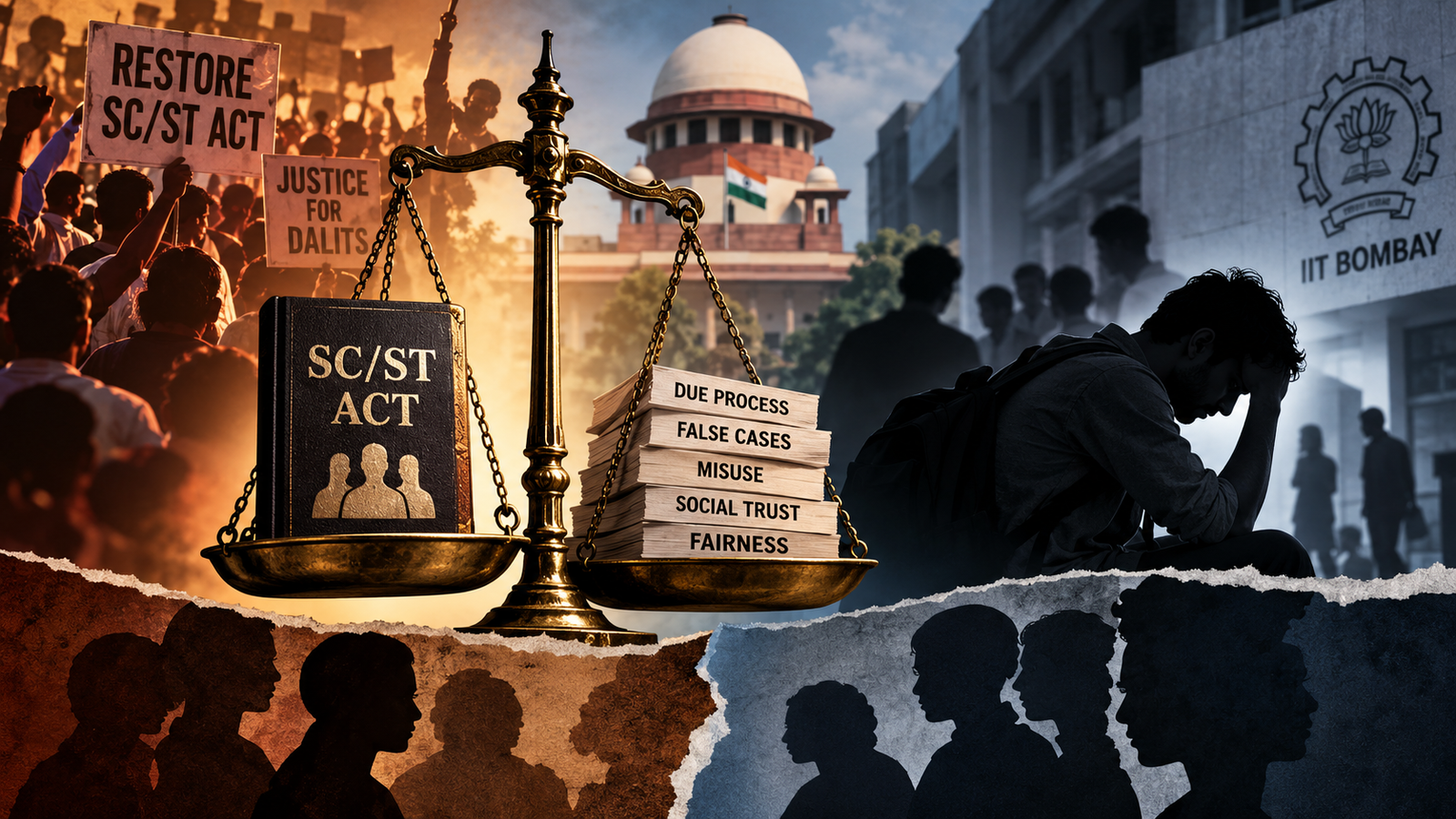
India has spent decades trying to address caste discrimination. But in attempting to correct one injustice, the law must also be careful not to create another form of legal imbalance.
The recent tragic suicide of IIT Bombay student Sahil Wakode has once again brought the debate surrounding the Scheduled Castes and Scheduled Tribes (Prevention of Atrocities) Act into public attention. The case itself is still under investigation, and allegations of caste discrimination must be established through evidence. But the controversy has raised a much larger question that India has repeatedly struggled to confront:
How far can a law go in protecting one category of citizens before its stringent provisions begin to raise legitimate concerns about due process, misuse and the rights of those accused?
That is not an attack on the purpose of the SC/ST Act.
It is a question about the consequences of giving any law exceptional power.
How Did the Law Become So Stringent?
The present debate cannot be separated from what happened in 2018.
In March 2018, the Supreme Court introduced certain safeguards in cases under the SC/ST Act, including requiring a preliminary inquiry in appropriate circumstances before registration of an FIR and approval before arrest of a public servant.
The judgment was immediately followed by widespread protests across the country. Dalit organisations called a nationwide Bharat Bandh against what they described as the dilution of the Act. The protests witnessed violence in several parts of India and resulted in deaths.
The political response was swift.
Within months, Parliament amended the law to effectively overturn the safeguards introduced by the Supreme Court. The amendment removed the requirement of a preliminary inquiry before registration of an FIR and clarified that prior approval was not required for arrest. It also restored the statutory restriction on anticipatory bail.
Contemporary reporting at the time openly discussed the political pressure surrounding the issue. India Today reported that the government was facing pressure from Dalit groups and political allies, while the approaching elections in states with significant SC/ST populations also formed part of the political context surrounding the restoration of the stringent provisions.
This does not prove that electoral considerations were the government’s only motivation. The government itself argued that the Supreme Court judgment weakened protections under the Act and that restoring the original provisions was necessary.
But it would also be difficult to ignore the political circumstances surrounding the decision.
When a government faces nationwide protests from one section of society, pressure from political allies and an approaching national election, political incentives inevitably become part of the context in which legislation is debated.
And this is precisely where the larger question begins.
When Political Pressure Shapes Criminal Law
A criminal law should ideally be designed around principles of justice, evidence and proportionality — not around which community can mobilise the strongest political pressure.
The 2018 episode created a perception among many citizens that the government was unwilling to be seen as taking any position that could be interpreted as “anti-SC/ST”, particularly after the nationwide protests against the Supreme Court judgment.
The political calculation is understandable from the perspective of electoral politics. But criminal law should not be insulated from scrutiny simply because questioning it may carry political costs.
If a provision has serious consequences for an accused person, the question of safeguards should remain legitimate irrespective of the identity of the complainant or the accused.
The Problem Is Not the Objective. It Is the Imbalance.
The central criticism of the present framework is not that caste-based atrocities should be ignored.
The problem is what happens when extraordinary legal consequences are triggered at the complaint stage, before the underlying allegation has been conclusively established.
The SC/ST Act contains stringent provisions concerning arrest and anticipatory bail. Following the 2018 amendment, a preliminary inquiry is not required before registration of an FIR under Section 18A, and the statutory bar on anticipatory bail remains.
This creates a situation in which an accusation under the Act can potentially place an individual in a very serious legal position at an early stage of the proceedings.
That does not mean every complaint is false.
It means something simpler:
The more powerful the law, the stronger the safeguards against its deliberate misuse should be.
A law does not become unfair merely because it is strict. But strictness without adequate mechanisms to deal with deliberate misuse can create fear and resentment.
What Happens If the Allegation Is False?
This is where the debate becomes particularly uncomfortable.
There is a tendency to respond to concerns about false complaints by saying that genuine victims might be discouraged from coming forward. That is a legitimate concern.
But the opposite concern is equally legitimate:
What protection does a person have when a serious allegation is deliberately fabricated against them?
And here an important distinction must be made.
A complaint that is ultimately unproved is not automatically a fake complaint. An acquittal does not automatically mean that the complainant lied. But where deliberate fabrication is actually established, there should be a meaningful legal remedy.
The issue becomes particularly serious when the consequences of the accusation — arrest, social stigma, professional consequences and prolonged litigation — arrive much earlier than the final determination of whether the allegation was true.
A legal system cannot simply say that the accused can eventually prove his innocence.
The process itself has consequences.
The Question of Compensation
The system also provides for monetary relief to victims at different stages of proceedings under the applicable rules.
The purpose is understandable: genuine victims should not be left without immediate support.
But this creates another policy question that deserves serious discussion:
What happens to such financial relief if the allegation is subsequently found to have been deliberately fabricated?
Where deliberate fabrication is established, the law should provide a clear and effective mechanism for dealing with the consequences — including the financial consequences where appropriate.
That is the kind of safeguard that deserves legislative discussion.
Former CJI B.R. Gavai Has Raised the Same Concern
This concern is not merely coming from critics of the legislation.
Former Chief Justice of India B.R. Gavai has himself spoken about the possibility of misuse of the SC/ST Act. He has said that he has seen instances of misuse and suggested that Parliament, rather than the judiciary, should consider appropriate safeguards.
Importantly, Justice Gavai has not argued that the Act should be abolished. His position has been that the protective purpose of the law should remain while deliberate misuse should attract consequences.
NDTV reported on Justice Gavai’s remarks regarding alleged misuse and safeguards.
That is an important distinction.
The debate therefore does not have to be:
“Keep the law exactly as it is” versus “abolish the law.”
There is a third possibility:
Retain strong protection, but strengthen safeguards against demonstrable misuse.
The Psychological Problem Nobody Wants to Discuss
There is also a deeper social consequence.
When criminal law is structured around legally significant caste categories, it can unintentionally reinforce the very category consciousness that society is otherwise trying to reduce.
An ordinary dispute between two individuals can suddenly acquire a completely different character once it becomes a dispute between caste identities.
The psychological effect can become:
“He is from that category. I am from this category.”
And gradually, an individual dispute becomes a community dispute.
This is where the “us versus them” mentality can emerge.
The consequence is not necessarily immediate or measurable through an FIR statistic. It is a change in how people perceive one another.
If people begin to believe that an interaction with someone from another caste carries a potential legal risk because of how an allegation might later be characterised, social trust suffers.
That is not something India should want.
A Law Should Protect Citizens — Not Make Them Fear One Another
The purpose of criminal law should ultimately be to punish wrongdoing and protect citizens.
It should not create a social environment where people become excessively conscious of caste identities in their everyday interactions.
And this concern should not be interpreted as an argument against SC/ST citizens.
It is an argument against any legal structure that can deepen the psychological divide between citizens.
The objective should be to make caste less relevant to everyday life, not permanently place caste at the centre of every dispute.
The Fear of Interaction Is a Real Policy Concern
This concern should not be dismissed merely because it is difficult to measure.
If a professor begins worrying that a disciplinary action could potentially be interpreted through a caste lens, or if an employer becomes excessively cautious about ordinary workplace disputes, or if students become hesitant to interact with one another because they fear that an argument could escalate into a criminal allegation, something has gone wrong at the level of social trust.
Former CJI Gavai has also spoken about the concern surrounding misuse while maintaining that such concerns should not become a reason to abolish the legislation. His comments instead point towards safeguards against deliberate misuse.
The IIT Bombay Case Should Not Be Used to Prejudge the Law — But It Can Trigger a Necessary Debate
The Sahil Wakode case itself remains unresolved.
The CCTV footage reportedly shows Sahil Wakode using a phone during the examination and subsequently being escorted out of the examination hall. But the footage does not establish everything that happened afterward, nor does it independently establish or disprove the allegations of caste discrimination.
India Today’s report on the CCTV footage describes the sequence inside the examination hall, while The Indian Express reported on the police investigation into the footage and surrounding events.
Those questions must be investigated.
But the larger debate should not disappear merely because this particular case remains unresolved.
If caste discrimination occurred, it deserves investigation and appropriate action.
If an allegation is deliberately fabricated, that too deserves consequences.
And if the evidence ultimately establishes something else, that conclusion must also be accepted.
The point is not to use one tragic case to declare the entire law either good or bad.
The point is to ask whether the law, as currently structured, contains sufficient safeguards to maintain public confidence in its fairness.
A Law Can Be Necessary and Still Need Reform
This is where the conversation often becomes unnecessarily polarised.
Criticising a provision of the SC/ST Act does not automatically mean denying the existence of caste discrimination.
And supporting protection under the law does not require believing that every provision of the law is beyond criticism.
Both things can be true:
Caste discrimination exists.
And laws created to combat it can potentially be misused.
The existence of one does not logically disprove the other.
The real test of a mature legal system is whether it can acknowledge both realities without becoming afraid of either conversation.
What Safeguards Should Look Like
The objective should not be to make the SC/ST Act toothless.
It should be to make its use more accountable.
- Clear consequences for demonstrably fabricated complaints: Where deliberate fabrication is established, the law should provide an effective and proportionate remedy.
- Stronger investigation standards: Investigations should be evidence-based, properly documented and conducted by appropriately trained officers.
- Judicial scrutiny: Courts should retain the ability to examine whether the ingredients of an offence are prima facie established.
- Protection against retaliation: Safeguards should not prevent genuine victims or witnesses from coming forward.
- Accountability for deliberate misuse: Where intentional fabrication or malicious misuse is proved, appropriate consequences should follow.
The Way Forward
India should not be forced into choosing between protecting SC/ST citizens and protecting the rights of everyone else.
The better question is:
Can we protect genuine victims without making an accusation itself disproportionately powerful?
Can we ensure that a genuine victim receives immediate protection while also ensuring that a person who is deliberately falsely accused has a meaningful remedy?
Can we retain stringent punishment for genuine atrocities while creating consequences for deliberate fabrication?
Can we enforce a law designed around caste discrimination without allowing caste identity to become an ever-present source of social division?
These are uncomfortable questions.
But uncomfortable questions are precisely the ones a mature democracy must be willing to ask.
The SC/ST Act should not be above criticism simply because its stated objective is socially important.
Nor should criticism of the Act be interpreted as hostility towards the communities it protects.
A law can have a legitimate purpose and still require safeguards. A law can protect citizens and still be capable of misuse. Recognising one does not require denying the other.
The objective should therefore not be to weaken protection.
It should be to ensure that the extraordinary power of the law is matched by equally credible safeguards against its deliberate misuse.
Because ultimately, the credibility of any law depends not only on how strongly it protects the victim, but also on how confidently it protects the principle of justice itself.
Sources and Further Reading
- India Today — SC/ST Act: From dilution to restoration in five months
- India Today — Why Dalit organisations protested the Supreme Court ruling
- The Indian Express — IIT Bombay student suicide and allegations of caste bias
- The Indian Express — CCTV footage and police investigation
- India Today — CCTV footage from the IIT Bombay examination hall
- NDTV — Former CJI B.R. Gavai on alleged misuse of the SC/ST Act